That there is an American Kestrel. According to Wikipedia…
… it is not actually a kestrel in the phylogenetic sense. Instead, a process of convergent evolution to fit a similar small prey niche in the ecosystem as the true kestrels have left it with similar physical characteristics and hunting methods.
Little birds are so cute. Then you observe them going after their prey, imagine if they were larger, and then remember their ancestry. Yeah, they’re cute.
Square-cube law means that as they get bigger they need to hunt less (lower rate of heat loss per kg of birb) and get less powerful compared to their size
I doubt such a law is a linear function, and probably plateaus at some point. I wouldn’t consider large birds even outside raptors as weak because they are big, and dinosaurs? Maybe clarify what you mean as “less powerful”.
Even outside the bird family, what about huge animals like orca, elephants, rhinos?
I meant weaker per kg of body weight, not in absolute terms
the square-cube law is the fact that a larger object has a lower ratio of surface area to volume than a similarly-shaped smaller object; i.e. as the scale of an object increases linearly, its surface area increases as a square function, and its volume increases as a cubic function.
thermodynamically, this means an object twice the size has 4 times the heat transfer (which occurs at the outer surface), but 8 times the heat capacity (since heat is stored throughout the volume). so it’s heat loss is by raw numbers greater, but lower as a percentage of the total, i.e. the internal temperature is more stable
Their prey don’t agree with you
My favorite tiny little murder birb!
There’s at least one falconer on YouTube who gets hired to reduce starling populations (which is sad because I love the laser birds too but they’re invasive) and he literally drive-bys them by yeeting a kestrel out the window of the moving car. It’s incredible to watch.
Could you find a link or do you remember the channel name? I think falconry is really awesome and I’d love to see that
This is one of them. It’s probably the best channel because he posts videos about how he trains the kestrals and also videos about other birds and rehabbing them.
Thank you so much! I’ll check it out
Kestrels are so feisty! Kestrel fighting a Barn Owl
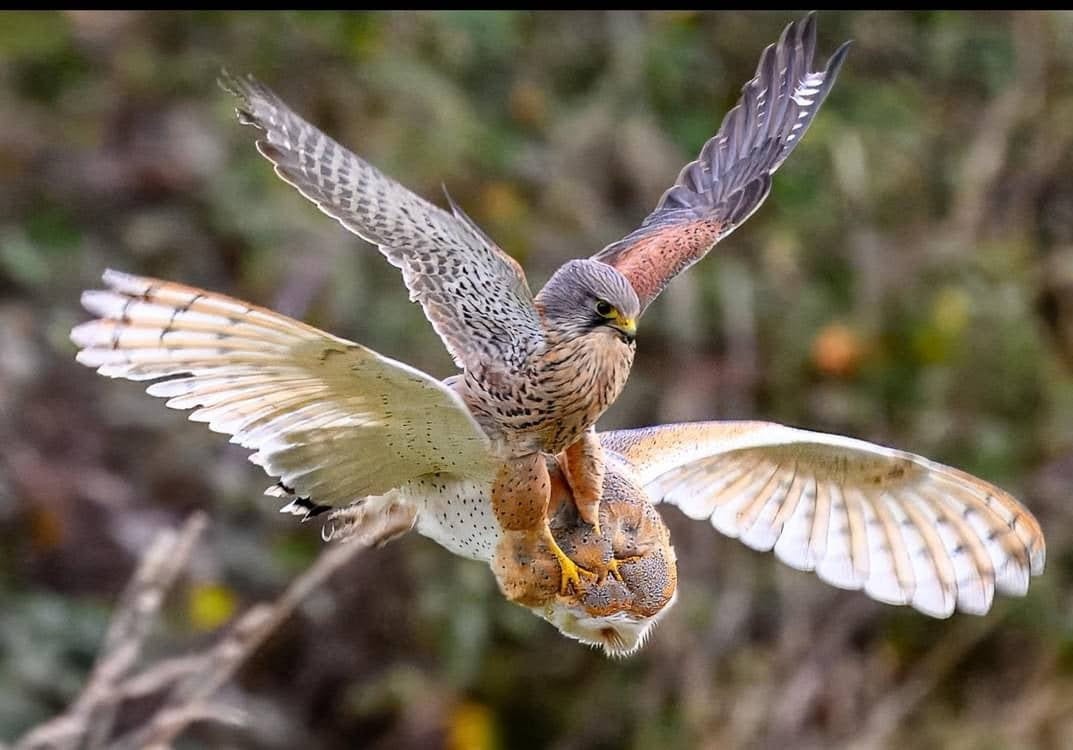
Kestrels(falconiformes) are more closely related to parrots so kinda makes sense.
Kestrels and falcons are each others closest relatives.
Both are more closely related to parrots than to kites hawks and eagles. In fact falcons are more closely related to tits than to hawks. But tits are more closely related to parrots than to falcons. Fuck, eagles and hawks are more closely related to woodpeckers than to falcons.
Bird cladistics is wild!
I am never gonna finish the seating chart for this fucking banquet
I’ve learned today I know nothing about avian evolution. I’m now classified as “amateur bird watcher”, only slightly higher than “I think that’s a pigeon”
Where can I subscribe for more facts about tits and peckers?
Clints Reptiles for more interesting cladistic facts. https://youtu.be/7xv3NLGO5do
or Ze Frank for: Wow, look at those boobies! https://youtu.be/oGdVSvsiaOk and New Caledonian Crows don’t have the right peckers. https://youtu.be/B-HF-wBwQsc
On tour at a raptor rescue center.
Tour goes into their small raptor “play” enclosure, there more to keep them safe from the wild raptors in the area.
They bring in this tiny and adorable kite, it took some offered bits of food(bits of raw meat provided by the center) from us.
Wild Junco(that we previously had not noticed) in the enclosure did not agree about the cuteness of the kite. (It got out unharmed.)
In the western hemisphere there is also the Bat Falcon (they are known to hunt hummingbirds too). In Africa there is the Pygmy Falcon.
And the smallest falcon in the world is in Malaysia: Black-thighed Falconet
typically measuring between 14–16 centimetres (5.5–6.3 in) long, with a 27–32 centimetres (11–13 in) wingspan, which is a size comparable to a typical sparrow
This falconet mainly feeds on insects, including moths, butterflies, dragonflies, alate termites and cicadas, occasional small birds, and lizards. Feeding behavior appears to often be social, with feeding parties up to ten recorded.